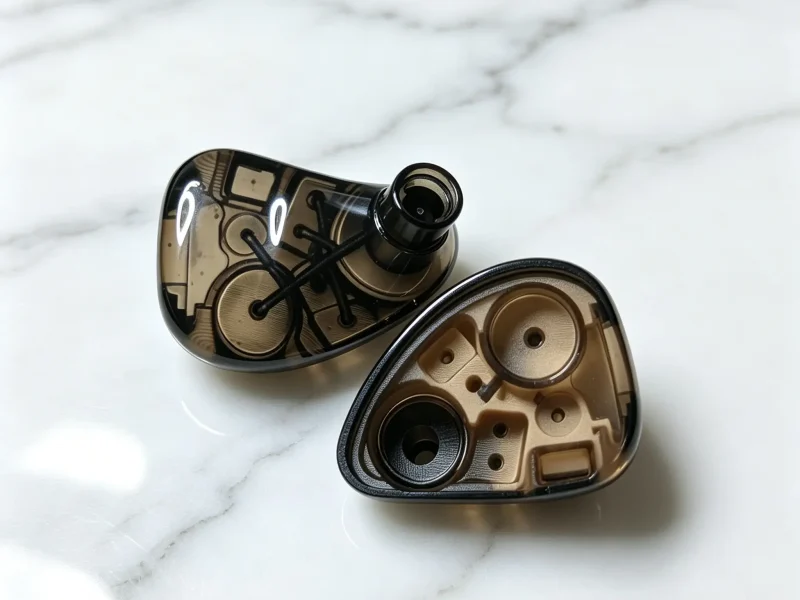
Nozzle geometry and mesh selection often get overlooked. Driver count and shell material draw more focus, yet nozzle and mesh directly shape the sound and production tuning of multi-driver IEMs.
3D Printed Internal Acoustic Nozzles
Multi-driver and hybrid IEM builds use 3D printed internal nozzles to create separate acoustic channels inside the shell. Each driver gets its own routing path rather than sharing a single open cavity.
This separation matters for airflow, not comfort. Balanced armatures deliver high-frequency sound. Dynamic drivers produce low-frequency sound. These two signals behave differently while traveling inside the shell to the nozzle exit. Separate acoustic paths cut down phase interference between drivers. This interference occurs when multiple sound sources arrive at the ear canal out of sync or with overlapping frequencies.
3D printing also lets us optimize internal space more precisely. Complex multi-BA or hybrid layouts don’t leave much room to work with, and a printed nozzle can route around driver placement in ways a simple molded tube can’t. Our [Custom IEM Nozzle & Shell Design] work in this category is built around this exact routing problem — fitting multiple independent channels into a shell that has limited internal volume to begin with.
Silicone Nozzles
Silicone nozzles are simpler by design. They’re molded as single tubes without internal channel separation, which makes them easy to install and compatible with a wide range of DIY or basic IEM builds.
The trade-off is space and routing capability. A silicone nozzle takes up more internal shell volume than a printed channel structure, and it doesn’t offer a way to separate airflow paths for multiple drivers. This makes it a reasonable choice for entry-level, single-driver, or simple dual-driver designs, where there’s no complex internal routing problem to solve in the first place. It becomes a limiting factor once a design moves into denser multi-driver territory.
Tuning Mesh Selection
The mesh sitting at the nozzle opening does more than block dust. It functions as a passive acoustic damper, and mesh density changes how the driver’s high-frequency output behaves before it reaches the ear.
500 mesh has smaller openings and higher acoustic resistance. This adds more damping at the top end, which helps control harsh high-frequency peaks and smooths out treble that would otherwise sound sharp or fatiguing. 300 mesh has larger openings and lower resistance, letting more high-frequency detail and air through, but with less damping control over peaky driver behavior.
Neither mesh is universally correct. The right choice depends on how the driver behaves on its own, the nozzle geometry it’s paired with, and what the target frequency response actually calls for. [IEM Tuning Mesh & Acoustic Components] selection happens after driver and nozzle decisions are locked in, not before — mesh is one of the last adjustments made during final tuning, not a starting point.
Q&A
Q1: What is the main difference between 3D printed nozzles and silicone nozzles in IEM production?
A: 3D printed nozzles allow internal acoustic channel design for multi-driver IEMs. Silicone nozzles are simpler, take more internal space, and are better for basic or DIY builds.
Q2: When should a factory choose 500 mesh instead of 300 mesh?
A: Choose 500 mesh when high frequencies need more damping control. Choose 300 mesh when the target sound needs more openness and high-frequency detail.
Q3: Can nozzle and mesh design replace electronic crossover tuning?
A: No. Nozzle geometry and tuning mesh are passive acoustic adjustments. They work together with driver selection, crossover design, and shell volume, but do not replace proper crossover tuning.
Related Reads:Call Center IEMs & Business Headsets for High-Volume Voice Communication
Industrial Custom IEMs & Communication Earpieces for High-Noise