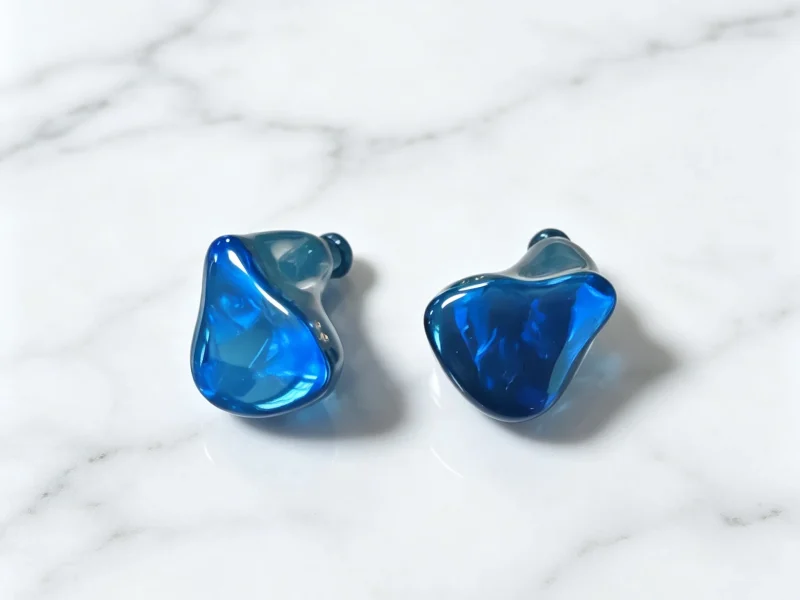
More drivers do not automatically mean better sound, better monitoring, or better hearing safety. In custom IEM manufacturing, driver count is only one variable. The final performance depends on crossover design, acoustic tuning, shell volume, seal quality, and how the performer actually uses the monitor on stage.
For brands sourcing custom IEMs, the bigger risk is not choosing too few drivers. It is choosing a driver configuration that does not match the intended use, the target price, or the production tolerances of the factory.
Why Brands Ask for More Drivers
Buyers often request 4, 6, 8, or even 10+ driver configurations because higher driver counts are easy to market. They also create a clear product ladder:
- entry-level single or dual driver models;
- mid-range 2–4 driver models;
- flagship 6+ driver models.
This structure works commercially. But from an engineering standpoint, adding drivers only makes sense when each driver has a defined role. A well-designed multi-driver IEM separates frequency bands so that each driver works within its optimal range. That can reduce distortion and improve clarity in the highs, mids, or lows.
However, once drivers exceed a certain point, the benefits become smaller while the complexity grows fast.
Where Extra Drivers Stop Helping
Custom IEM shells have limited internal space. Every additional driver reduces room for acoustic tubing, damping material, venting, and crossover components. If the cavity is too crowded, several problems appear:
- Crossover complexity increases. Poorly tuned crossovers can create phase issues, uneven frequency response, or harsh transitions between drivers.
- Acoustic interference becomes harder to control. Multiple nozzles and internal tubes can interact in unpredictable ways.
- Consistency drops. A design that depends on extremely tight tolerances is harder to reproduce across hundreds or thousands of pairs.
- Impedance and sensitivity change. Some multi-driver designs become more demanding to drive, which can affect wireless pack compatibility.
- Repair and service become harder. More internal components mean more failure points.
For B2B buyers, this matters because a flagship design must be repeatable. A prototype that sounds excellent in one hand-built pair is not the same as a production run with stable yield.
Why Single and Dual Driver IEMs Still Win
Single and dual driver IEMs remain popular for good reasons. They are not “entry-level” by default. Many professional musicians, broadcast engineers, and industrial users prefer them because they offer strong coherence, reliable performance, and lower maintenance.
A single balanced armature driver can deliver excellent vocal clarity and consistent output. A single dynamic driver can provide natural low-frequency response without complex filtering. A dual driver design, such as one dynamic driver plus one balanced armature, often covers most stage monitoring needs without introducing excessive crossover risk.
These configurations also tend to be more power-efficient. That is important for users running wireless IEM systems, where battery life and clean output matter.
For brands building a practical product line, a well-tuned dual driver model often delivers better customer satisfaction than a poorly executed 6-driver flagship.
Hearing Safety Is Not Determined by Driver Count
Driver count does not protect hearing. Passive isolation, fit, filter choice, and listening level do.
A musician wearing a poorly sealed 8-driver IEM may raise the mix volume to compensate for leakage. That increases exposure risk. A musician wearing a well-sealed 2-driver IEM with appropriate attenuation can often monitor clearly at a lower, safer level.
In industrial and outdoor environments, the same principle applies. High driver counts do not make an IEM safer. What matters is whether the shell fits correctly, whether the attenuation level matches the environment, and whether the user can still hear necessary communication.
Brands should avoid implying that more drivers equal better hearing protection. That claim is not supported by acoustics or compliance standards.
What B2B Buyers Should Evaluate
When evaluating a custom IEM program, driver count should come after these questions:
- Who is the end user? Touring musicians, worship teams, DJs, industrial crews, and audiophiles do not need the same tuning.
- What is the target SPL environment? Loud stages, rehearsal rooms, outdoor events, and industrial sites have different requirements.
- Can the factory reproduce the design consistently? Multi-driver designs require stable assembly processes.
- How will the product be positioned? Monitoring, hearing conservation support, and certified PPE are different categories.
- What is the service plan? Filters, cables, nozzles, and re-shells should be easy to support.
For brands improving fit accuracy at the start of the process, reliable [Custom Ear Impression Kits] help reduce shell remakes and improve first-fit isolation. For tuning and attenuation options, [High-Attenuation Acoustic Filters] can be integrated into both musician and industrial-focused models without redesigning the entire shell platform.
Common Mistakes in Multi-Driver IEM Programs
- Using driver count as the main selling point. This pushes engineering toward marketing numbers instead of listening performance.
- Copying flagship specs without tuning capability. A crossover that works in one lab setup may not translate to mass production.
- Ignoring impedance and sensitivity. Some multi-driver IEMs behave unpredictably with different wireless packs.
- Overlooking seal quality. No amount of driver separation fixes a leaking fit.
- Mixing monitoring and PPE claims. Custom IEMs can support safer listening, but they are not automatically certified hearing protection.
Q&A
Q: Is a 4-driver IEM always better than a 2-driver IEM?
No. A well-tuned 2-driver IEM can outperform a poorly tuned 4-driver model. Driver count matters less than crossover design, acoustic tuning, and fit.
Q: Do more drivers improve hearing protection?
No. Hearing safety depends on isolation, fit, filter attenuation, and listening level. Driver count does not determine protection.
Q: When do multi-driver IEMs make sense?
They make sense when the brand needs extended frequency separation, higher detail retrieval, or a clear flagship tier, and when the factory can maintain consistent crossover tuning.
Q: Are single driver IEMs still relevant for professionals?
Yes. Single driver designs offer strong coherence, simple impedance behavior, high reliability, and often excellent vocal clarity.
Q: What should an OEM buyer check before launching a multi-driver line?
Check crossover reproducibility, driver sourcing stability, assembly yield, impedance curves, sensitivity, filter options, and after-sales service requirements.
Related Reads:Custom IEMs for Industrial and Outdoor Use
Custom IEMs for Musicians: Monitoring and Hearing Safety Custom IEMs: Can They Be Used for Hearing Protection?