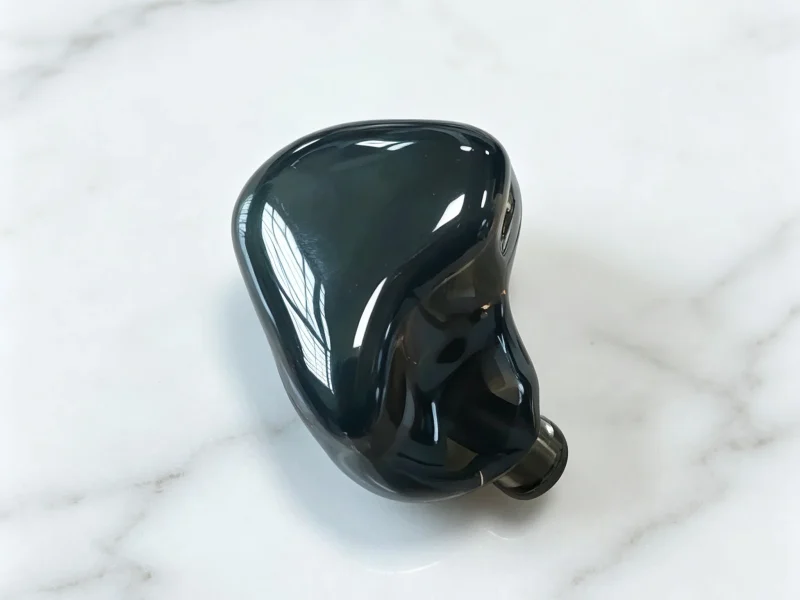
Driver count means nothing without a target application. Configuration decisions get made against frequency response goals and use case, not spec sheet bragging rights.
Hybrid Configurations (1DD + 2BA)
A hybrid layout splits the frequency spectrum by driver type. First, the Dynamic Driver (DD) handles low-frequency output. It moves enough air to produce physical bass impact that a Balanced Armature (BA) simply can’t replicate on its own. Consequently, the BA units are left to cover the midrange and treble. In this range, speed and detail retrieval matter far more than raw air displacement.
Specifically, this configuration is engineered for a clear consumer profile: listeners who prioritize bass response. For instance, they often run pop and electronic material where sub-bass presence and rhythmic punch drive the mix. The crossover point typically sits around 800Hz to 1kHz. This is the exact frequency range where DD output hands off to BA output. However, if you get that crossover point wrong, you will encounter a blended tonal gap or overlap. This results in either a dip in perceived warmth or a buildup that muddies the low-mid transition.
[Custom IEM Driver Configuration] work for hybrid builds centers on this handoff point specifically. Crossover integration isn’t a fixed formula; it shifts based on the specific DD and BA units paired together, and it needs measurement-based verification, not assumption.
All-BA Configurations (3BA / 5BA)
All-BA layouts split the frequency spectrum across multiple Balanced Armature units without a Dynamic Driver in the chain. BAs deliver faster transient response and higher resolution than a DD, since their diaphragm mass and excursion characteristics differ fundamentally from dynamic driver mechanics. What they don’t deliver is natural sub-bass rumble — a BA can approximate low-frequency output, but it lacks the physical air displacement a DD produces.
This trade-off makes all-BA configurations the standard choice for studio monitors, audiophiles, and musicians who need critical midrange clarity and instrument separation over sub-bass extension. A 3BA or 5BA layout, properly crossed over, resolves fine detail in vocal and instrument-dense material more precisely than a hybrid design tuned for bass impact.
[IEM Acoustic Tuning Services] for all-BA builds focus on managing crossover distortion between adjacent BA units and applying acoustic damping at the nozzle to control resonance peaks that multi-BA layouts are prone to producing without correction.
Q&A
Q1: How does impedance matching affect multi-driver IEM performance?
A: Impedance mismatches between drivers and the crossover network cause uneven current distribution across the frequency spectrum, leading to response irregularities at the handoff points. Matching impedance across the driver set keeps output level consistent through crossover transitions.
Q2: What causes crossover distortion in multi-BA configurations?
A: Crossover distortion occurs when adjacent driver outputs overlap incorrectly at the transition frequency, either from poor component tolerance in the crossover network or from acoustic interference inside the shell. Precise crossover point placement and shell chamber design both factor into minimizing it.
Q3: Why does hybrid crossover placement shift between different DD/BA pairings?
A: Each DD and BA unit has its own natural frequency response curve and impedance characteristics. Crossover point placement has to account for where each specific driver’s output starts degrading, which varies by component, not by a fixed industry standard.
Related Reads:
IEM Nozzle & Tuning Mesh Design
Call Center IEMs & Business Headsets for High-Volume Voice Communication