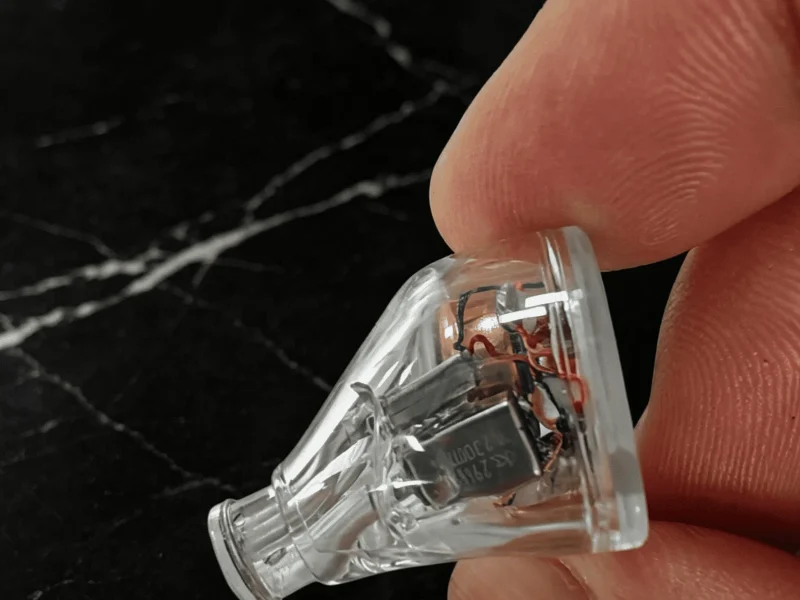
Yes, with technical caveats. A custom IEM provides passive attenuation when the acoustic seal is correct and the filter is specified for the exposure. It is not certified hearing protection unless the specific design has been tested and labeled as such.
The Seal Is the Primary Variable
Passive attenuation depends on the acoustic seal, not on the driver or the filter. If the seal leaks, nothing downstream compensates for it.
The seal is set by two manufacturing inputs: the ear impression and the shell. The impression has to capture the canal and concha geometry accurately, with the jaw in a representative position. The shell has to reproduce that geometry within tight tolerance. A leak path on the order of 1mm along the canal seal can sharply cut attenuation, and low frequencies are affected most. Low-frequency energy bypasses small gaps easily, so a poor seal shows up first as lost low-frequency attenuation.
For this reason, a Noise Reduction Rating (NRR) cannot be transferred from one product to another. A published rating describes a tested device with a tested fit. A custom shell has to be evaluated on its own fit, and the impression is where that starts. Our [Custom Ear Impression Kits] are specified with this in mind: impression material viscosity, canal depth, and retention all affect how well the finished shell holds its seal.
Attenuation Filters: Music vs. Industrial Specification
Most custom IEMs sold for music use are not built as attenuators. Where an attenuation filter is fitted, it is typically a music-grade filter, commonly offered in steps such as -9dB, -15dB, and -25dB. These are designed to lower level while keeping the response as linear as possible, so speech and music stay balanced rather than muffled.
Flat attenuation comes from the acoustic elements inside the filter. Meshes and baffles add controlled acoustic resistance, and the filter geometry is tuned so attenuation stays close to uniform across the frequency spectrum. A filter that attenuates highs more than lows produces a dull, boomy sound, which is the usual behavior of a basic foam or solid plug.
Industrial-grade attenuation has a different goal. It targets higher, specified attenuation values for a defined noise exposure, and frequency response linearity is secondary to meeting the attenuation target. It requires higher-resistance elements and tighter control of the filter’s acoustic path. Our [High-Attenuation Acoustic Filters] are specified by attenuation target and tested at the filter level, but filter attenuation is only one input. The seal still determines how much of it the wearer actually receives.
Material Safety
Shell and tip materials matter for long-term wear in heat and sweat. We use medical-grade resins, including PMMA (acrylic) for hard shells, and soft silicone for flexible shells and tips. These materials are chosen for skin contact, hypoallergenic behavior, and dimensional stability under temperature and moisture. Soft silicone also tolerates repeated insertion and jaw movement better than rigid acrylic in some applications.
Material choice affects the seal over time. A shell that warps or swells under heat changes its seal geometry, and attenuation changes with it.
Limitations: Isolation Is Not Certified Protection
A standard music IEM is not certified safety equipment. Isolation describes how much outside noise a product blocks. Certified protection means a product has been tested to a recognized standard and carries a rating that can be relied on for a defined exposure.
Unless a specific model has been tested and labeled under the relevant standard, a manufacturer should not claim an NRR or equivalent for it. Buyers sourcing for occupational noise exposure should specify certified products and testing requirements in the purchase specification. Isolation from a well-fitted custom IEM is a useful benefit, but it is not a substitute for a rated safety product.
Q&A
What is the difference between NRR and SNR?
Both are single-number ratings of hearing protector attenuation, but they come from different regions and test methods. NRR is the US rating used on labeling and is derived from laboratory testing. SNR is the Single Number Rating used in European standards. The two values are not interchangeable, and neither can be assumed for an untested custom IEM.
Can I swap music filters for safety filters?
Swapping filters changes the attenuation of the filter element, but it does not certify the finished product. The shell seal, the filter fit, and the acoustic path all affect the result. Any swap should be evaluated as a complete assembly, and the finished unit should be tested before it is used for safety purposes.
How does venting affect protection?
A vent relieves pressure and reduces the occlusion effect, but it is also a leak path. A vented shell loses attenuation, mostly at low frequencies. Shells intended for protection are normally built without vents, or with vents that are acoustically damped and verified against the attenuation target.
Related Reads:Why Work With a China OEM IEM Manufacturer?
IEM Nozzle & Tuning Mesh Design; IEM Driver Configuration Guide