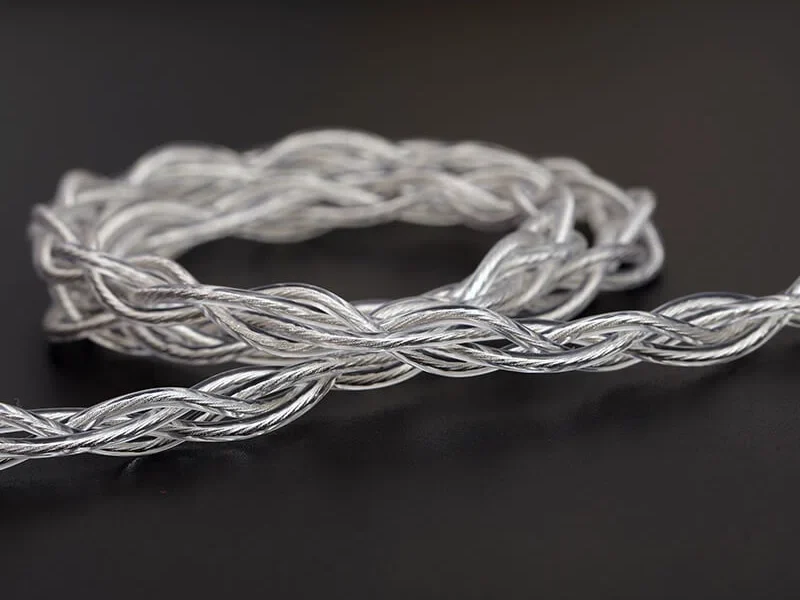
A custom braided audio cable is not just decoration bolted onto a finished product. It combines physics and mechanical engineering. We must consider how the cable handles current and withstands daily flexing. We also look at how it feels against a shirt collar during a commute. If you get the structure wrong, surface braiding cannot fix it.
The Engineering Behind a Custom Braided Audio Cable
Braiding pattern and internal structure are two different things, and it’s worth separating them clearly before going further. Structure refers to how the conductors themselves are built and insulated internally. Pattern refers to how the strands are woven together on the outside. Both matter, but they solve different problems.
Braiding patterns — whether 4-strand, 8-strand, or complex configurations — serve a functional purpose beyond cosmetics. A tight, well-executed braid distributes mechanical stress across multiple strands. This prevents stress concentration at a single point and improves tensile strength during repeated flexing. Braiding also changes how a cable behaves in your hand. A properly braided cable resists tangling and holds its shape better than a simple twisted pair. This matters for daily handling, storage, and coiling.
Durability under normal use depends on a specific combination: strand count, braid tightness, and jacket material must work together. A cable might look good in a product photo. However, if it kinks or frays after a few months of normal handling, it fails to solve the actual engineering problem.
Eliminating Microphonics: The Litz Structure Advantage
Litz structure — from the German Litzendraht, meaning “braided wire” — refers to a specific internal construction where multiple individually insulated strands are woven together within a single conductor bundle. Each strand carries a portion of the signal current independently, insulated from its neighbors.
This construction addresses two real electrical phenomena. The skin effect causes current to concentrate near a conductor’s outer surface at higher frequencies, effectively reducing the usable conductive area of a solid or non-Litz conductor. The proximity effect causes adjacent conductors to influence each other’s current distribution, further concentrating current unevenly. Litz structure counters both by spreading current across many individually insulated strands, keeping effective conductive area more consistent across the frequency range.
For B2B buyers and end users, the benefit that actually shows up in daily use is different from the electrical explanation, though it’s related: microphonics reduction. Microphonics are the audible thump and rustle transmitted through a cable when it rubs against clothing, brushes against a jacket collar, or gets caught on a bag strap during movement. A poorly structured cable transmits this mechanical noise directly into the signal path. A properly built Litz structure, combined with adequate strand insulation and jacket damping, meaningfully reduces how much of that friction noise reaches the driver. This is a comfort and usability metric first, and a signal-purity metric second — and for anyone wearing IEMs during commuting, workouts, or extended desk use, it’s the difference between a cable that’s tolerable and one that isn’t.
High-Purity Litz Audio Cable — built specifically for clean signal transmission and minimized microphonics, using individually insulated strands throughout the conductor bundle rather than a standard twisted or solid-core construction.
Visual Identity for Your Brand
Once the internal structure is settled, braiding pattern becomes a legitimate branding tool. Star quad braiding, helix patterns, and other distinct weave geometries give a cable a visual signature that’s recognizable at a glance — on a retail shelf, in product photography, or in a customer’s hand.
This matters for audio brands trying to differentiate a product line without touching the underlying acoustic performance. A distinct braid texture doesn’t change what’s happening electrically inside the cable — that’s determined by the internal structure — but it does give a brand a visual identity that’s harder for competitors to replicate outright compared to a generic black round cable. Consistent braid geometry across a product line also reinforces brand recognition the same way consistent packaging design does.
Custom Braided Cable Series (Star/Helix) — offering distinct braid geometries and premium jacket finishes for brands looking to establish a visual identity across their cable lineup without compromising on build quality or handling characteristics.
Q&A
Why is Litz structure better for audio?
It reduces signal distortion at higher frequencies by countering the skin effect and proximity effect, and it minimizes cable noise and microphonics through individually insulated strand construction. Both effects come from the same underlying design principle.
Does the braiding pattern affect sound?
Braiding pattern primarily affects durability, tangle resistance, and handling noise rather than the electrical signal itself. That said, consistent braid geometry helps maintain stable impedance along the cable’s length, which supports overall signal consistency.
Can we customize the braiding for our brand?
Yes. We offer multiple pattern options, including Litz-structured builds, star quad, and standard braid configurations, and can match pattern and jacket color to your brand’s existing product identity.
Related Reading:Bluetooth IEM Adapters: The Wireless Alternative to Balanced Cables
Pure Silver IEM Cables: The Flagship Standard
Call Center IEMs & Business Headsets for High-Volume Voice Communication