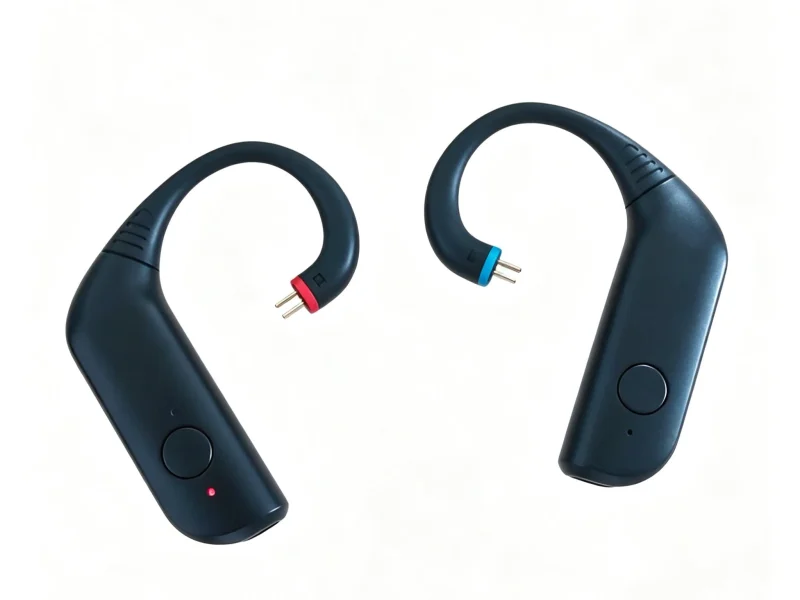
Wired IEMs deliver a signal path that many listeners refuse to compromise. However, that wire becomes a liability during a run, a commute, or while moving around with a laptop. A Bluetooth IEM adapter solves this directly. It clips onto your existing wired IEM shells and turns them into a true wireless setup. You get the convenience without needing a second pair of earphones.
The Wireless Alternative to 4.4mm Balanced Cables
A 4.4mm balanced cable performs a specific job well. It improves channel separation and reduces crosstalk compared to standard unbalanced connections. This matters for listeners who demand accuracy from a balanced source. However, it fails to solve mobility issues because you remain tethered to the source device.
A Bluetooth adapter changes this equation completely. It does not force you to choose between driver performance and wireless freedom. Instead, it keeps the driver assembly exactly as is and replaces the cable with a compact wireless module. You retain your preferred acoustic signature while losing the tether.
Many listeners have already invested in wired IEMs with a specific tuning they love. For them, this adapter offers a more practical upgrade path than buying a separate TWS product with a different sound signature. The driver stays the same; only the transmission method changes.
Universal Compatibility: 0.78mm 2-Pin & MMCX
Connector standardization matters here, because it determines whether an adapter actually works with the IEM you already own.
The two dominant standards in this category are 0.78mm 2-pin and MMCX. A 0.78mm 2-pin connector uses two parallel pins seated into corresponding sockets on the IEM shell — a stable, low-rotation connection common across a wide range of custom and universal-fit IEMs. MMCX uses a rotating barrel connection, which allows the cable (or in this case, the adapter) to pivot slightly relative to the shell, a design favored by some manufacturers for cable strain relief.
An ear hook-style Bluetooth adapter built with exposed pins matching these standards gives brands and end users a genuine “one adapter, multiple IEMs” proposition. Provided your IEM shells use standard 0.78mm 2-pin or MMCX sockets, the same adapter unit works across different IEM models in a collection — you’re not locked into a single pairing.
High-Fidelity Bluetooth Ear Hook Adapter (0.78mm/MMCX) — built as a direct replacement for a wired connection, this ear hook adapter connects straight to your existing IEM’s 0.78mm or MMCX socket, with an over-ear hook design for secure retention during movement and clearly marked L/R indicator rings for correct orientation.
Low Latency Performance for Gaming & Video
Bluetooth latency has historically been the sticking point for anyone trying to sync audio with on-screen action. Standard Bluetooth codecs can introduce noticeable delay between video and audio, which is a real problem for gaming and any latency-sensitive content work.
Adapters built around low-latency codec standards — such as aptX Low Latency or comparable proprietary implementations — bring that delay down to a range where audio-visual sync holds up under normal use. This matters specifically for gamers who need audio cues to line up with on-screen events, and for content creators monitoring audio while recording or editing video, where drift between audio and picture undermines the whole workflow.
Low Latency Audio Transmission Module — the transmission chipset inside the adapter is specced around low-latency codec support, prioritizing sync accuracy over marginal gains in raw file transfer bitrate.
Q&A
Does this replace my 4.4mm balanced cable?
For wireless scenarios, yes. It replaces the cable connection with a Bluetooth link, trading the pure analog signal path of a balanced cable for wireless convenience. If you need the absolute signal integrity of a balanced connection for critical listening or studio work, a wired cable remains the better choice for that specific use case.
Is the sound quality compromised compared to wired?
There’s some loss inherent to any Bluetooth transmission, since the signal passes through a codec rather than a direct analog path. With modern low-latency codecs, that loss is minimal for most listening scenarios, and the trade-off in mobility is generally worth it for commuting, sport, or everyday use.
Will this fit my custom IEMs?
Yes, provided your custom IEMs use a standard 0.78mm 2-pin or MMCX connector. Check your IEM’s connector spec before ordering, since non-standard or proprietary connector types won’t seat correctly.
Related Articles:Pure Silver IEM Cables: The Flagship Standard
OCC Silver-Plated IEM Cables: The Mid-Tier Volume Driver