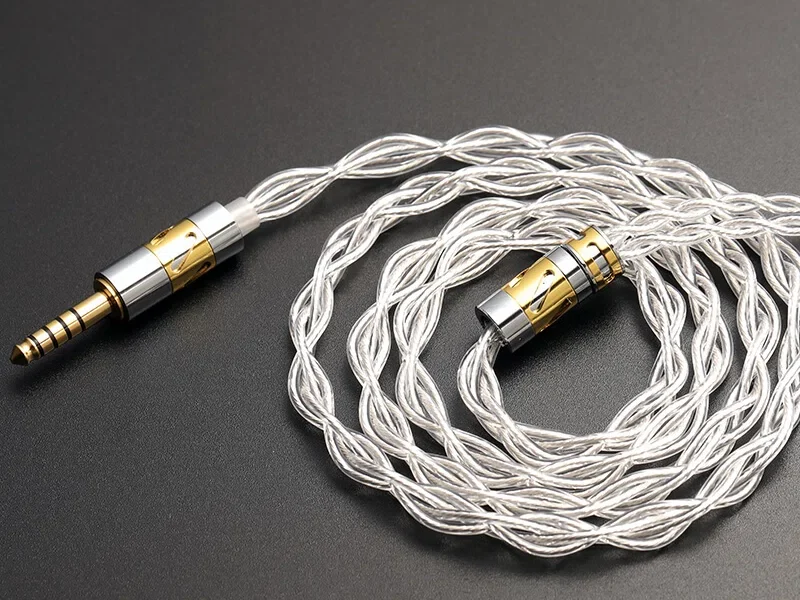
Mid-tier audio brands face a specific challenge. They need an upgrade cable that delivers real performance improvements while maintaining a healthy margin structure. This balance makes the product worth stocking as a dedicated SKU. A Silver-plated copper cable built on OCC (Single Crystal Copper) construction fits this position perfectly. It offers higher material quality and perceived value than entry-level OFC cables. Crucially, it avoids the high cost structure of full luxury cable lines.
The Science of Silver Plating (Skin Effect & High-Frequency Resolution)
At audio frequencies, current does not travel evenly through a conductor’s entire cross-section. As frequency rises, current concentrates increasingly toward the outer surface. Engineers call this well-documented electrical phenomenon the “skin effect.” Consequently, high-frequency signals travel at or near the conductor’s surface rather than through its core.
Silver has higher conductivity than copper, which matters for material selection. Plating a copper conductor with silver places this high-conductivity material exactly where high-frequency current concentrates: at the surface. Meanwhile, the copper core efficiently carries the broader signal load. This design improves high-frequency transmission compared to a bare copper conductor of the same gauge. Brands achieve this performance without constructing the cable from solid silver, which would substantially increase material costs.
OCC construction adds a separate but complementary benefit. Single Crystal Copper is drawn with a continuous crystal structure rather than the many small crystal boundaries found in standard multi-crystal copper. Fewer crystal boundaries mean fewer points where signal transmission is disrupted along the conductor’s length, supporting more consistent signal integrity across the cable overall.
Explore our OCC Silver-Plated IEM Cables for enhanced high-frequency clarity.
Perfect Match for Hybrid Drivers (Circle-Iron / Electrostatic)
This cable construction pairs specifically well with hybrid driver IEMs. These configurations combine a dynamic driver with balanced armature or electrostatic units. Industry professionals often refer to these as “circle-iron” hybrid designs. Such systems split frequency duties across different driver types. Typically, the dynamic driver handles low-frequency output. Meanwhile, balanced armature or electrostatic units manage midrange and high-frequency detail.
A 4-unit hybrid configuration relies on a reasonable balance across all three frequency bands at the output stage. Silver plating specifically improves high-frequency transmission characteristics. Therefore, it complements the range that balanced armature or electrostatic units already handle. This supports a more even representation across the low, mid, and high bands that the hybrid driver set is designed to reproduce.
Brands assembling a hybrid IEM product line must consider this pairing carefully. You should match the cable specification to the driver architecture. Do not treat the cable as a generic accessory interchangeable across every SKU in your catalog.
Why This Is Your Best-Seller (The Sweet Spot of Performance vs. Cost)
From a B2B sourcing and merchandising standpoint, OCC silver-plated cable occupies a specific commercial position worth understanding deliberately.
It carries strong perceived value. Silver plating and OCC construction are both established, recognizable terms among buyers researching cable upgrades, giving the product credibility without requiring exotic or unverifiable material claims. It supports strong upsell potential as a mid-tier option positioned between a basic OFC cable and a full premium cable line, giving distributors and retail partners a clear three-tier upgrade path to present to customers. And it maintains a healthy margin structure, since OCC and silver-plating material costs remain moderate relative to the retail premium this tier commands compared to base OFC cable.
For brands building out an accessory catalog, this combination — genuine technical differentiation, established terminology buyers already recognize, and margin that justifies dedicated inventory — is what typically makes this tier the highest-volume seller in a cable product line, more so than either the entry-level or high-end tiers.
Request OEM/ODM silver-plated copper cables for your brand or distribution channel.
OEM/ODM Customisation Options
Brands sourcing OCC silver-plated cable through OEM/ODM channels can specify conductor gauge and strand count based on target flexibility and durability requirements, connector type (2-pin, MMCX, or various termination options) to match their earphone platform, and cable jacket material and colour for brand consistency across a product line. Braided or sleeve finish options are also available for brands positioning this tier with additional visual distinction from base-level cable offerings.
Buyers should confirm connector compatibility with their existing earphone housing and specify target use case — general upgrade cable versus hybrid-driver-specific pairing — since this affects recommended conductor construction and gauge.
Q&A
What is the actual difference between OFC and OCC silver-plated cable?
OFC reduces oxide content in standard copper. OCC uses a continuous crystal structure with fewer internal boundaries, and silver plating adds a higher-conductivity surface layer that benefits high-frequency transmission specifically. OCC silver-plated cable represents a material upgrade over base OFC cable on both fronts.
Why does silver plating specifically help with high-frequency clarity?
At higher frequencies, current concentrates toward a conductor’s outer surface, a phenomenon known as the skin effect. Silver plating places a higher-conductivity material exactly at that surface, improving high-frequency signal transmission without requiring a solid silver conductor.
Is this cable only useful for hybrid driver IEMs?
No, but it pairs particularly well with hybrid configurations combining dynamic and balanced armature or electrostatic units, since silver plating’s high-frequency benefit complements the frequency range those additional driver types typically handle.
Why should we stock this as a dedicated mid-tier SKU instead of just offering base cable?
This tier offers genuine, explainable technical differentiation, strong buyer recognition of the terminology involved, and a margin structure that performs well as a distinct upsell step between entry-level and premium cable options.
What customisation options are available for OEM orders?
Conductor gauge, strand count, connector type, jacket material, colour, and sleeve finish can all be specified based on target product positioning and driver pairing.
Related Articles:OFC IEM Cables: Budget Audio Cable OEM
Call Center IEMs & Business Headsets for High-Volume Voice Communication