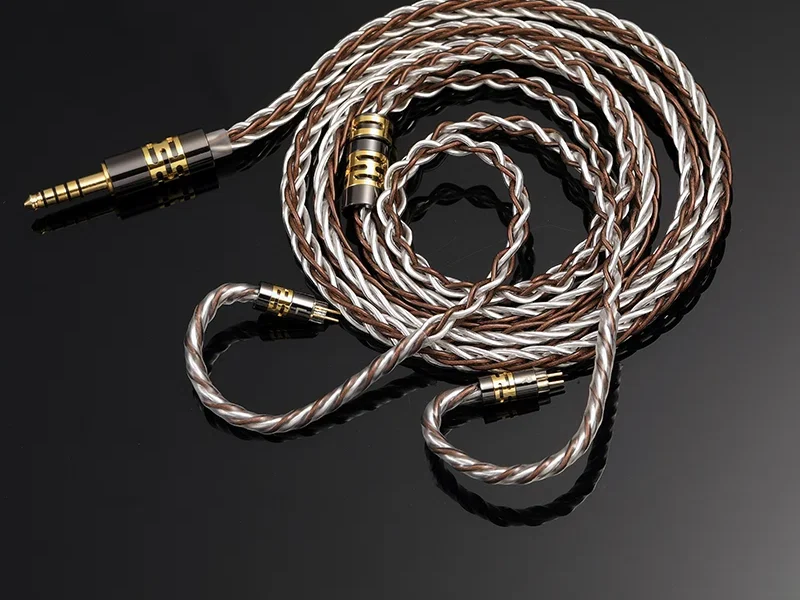
Entry-level audio brands need an upgrade cable option that improves on stock quality without pushing unit cost into premium territory. Brands typically design stock cables for $30-$100earphones to meet a price target, not a durability one. This trade-off often leads to customer complaints and warranty returns within months. OFC IEM Cable production addresses this gap directly — meaningfully better conductivity and durability than typical stock cable, at a cost structure that still fits an entry-level product line.
Why OFC Is the Industry Standard for Entry-Level
Oxygen-Free Copper removes oxide content that standard commercial-grade copper retains during smelting. Lower oxide content means more consistent conductivity along the cable’s length and less internal resistance variation from one production batch to the next. For entry-level products, this translates into a straightforward, verifiable improvement over generic copper-alloy stock cable without requiring exotic materials or complex construction.
OFC has become the practical default for budget audio cable OEM production for a specific reason: it delivers a real, measurable material improvement at a cost premium small enough to still fit a $30-$100 retail price point. This is different from high-end cable marketing built around exotic metals or elaborate shielding claims — OFC is a well-understood, consistently sourced material with a predictable cost structure, which matters more to a B2C brand’s margin planning than a marginal, hard-to-verify performance claim would.
Solving the “Stock Cable” Problem
Manufacturers usually construct budget stock cables from lower-grade copper alloy with stiff jackets. They make this choice specifically to minimize unit costs.. Over normal use, this combination shows up as two recurring failure patterns: jacket material hardening and cracking after repeated flexing, and oxidation-related conductivity loss at the connector and solder points over time.
OFC cable jackets, properly specified with a flexible PVC or TPE outer layer, retain softness and flexibility considerably longer under the same handling conditions. OFC’s inherent oxidation resistance also holds conductivity more consistently over the product’s service life, compared to standard copper alloy that oxidizes and degrades signal transmission faster under normal humidity and handling exposure. For brands fielding warranty claims tied to cable failure, this is the specific, addressable cause — not a vague durability complaint, but a traceable material and construction issue that a properly specified OFC cable corrects.
Explore our High-Purity OFC IEM Cables for budget-friendly upgrades.
OEM/ODM Customisation Options
Brands sourcing OFC cable through OEM/ODM channels can specify jacket colour to match existing product lines, connector type (2-pin, MMCX, or 3.5mm/2.5mm/4.4mm termination) to match their earphone platform, and cable length and Y-split configuration to fit specific product SKUs. Packaging can be customised for retail bundling or standalone accessory sale, depending on how the brand intends to position the product at checkout.
Buyers should confirm connector compatibility with their existing earphone housing before finalising a specification, since a mismatched connector standard is the most common sourcing error at this price tier.
Q&A
What does OFC actually mean, and why does it matter for a budget product line?
Oxygen-Free Copper has lower oxide content than standard commercial copper, giving more consistent conductivity and better long-term durability. It’s a verifiable, cost-effective upgrade over typical stock cable, which is why it fits entry-level product economics well.
How is OFC different from the stock cable already bundled with our earphones?
Manufacturers typically build stock cables from lower-grade copper alloys with stiffer jackets to minimize unit costs.. OFC cable offers better conductivity and jacket flexibility, and resists oxidation-related degradation over time.
Can OFC cables realistically increase order profit for a $20-$50 earphone line?
Yes, when positioned as a paired upgrade at checkout rather than a base-included component. The cost delta between stock and OFC cable is small relative to the retail markup available on the add-on.
What customisation options are available for OEM orders?
Jacket colour, connector type, cable length, and Y-split configuration can all be specified. We design packaging for either bundled retail sales or standalone accessories.
Is this cable designed for individual audiophile customers or B2B brand sourcing?
This is manufactured for B2B brand and distributor sourcing at OEM/ODM volume, not for individual consumer purchase or direct-to-audiophile marketing.