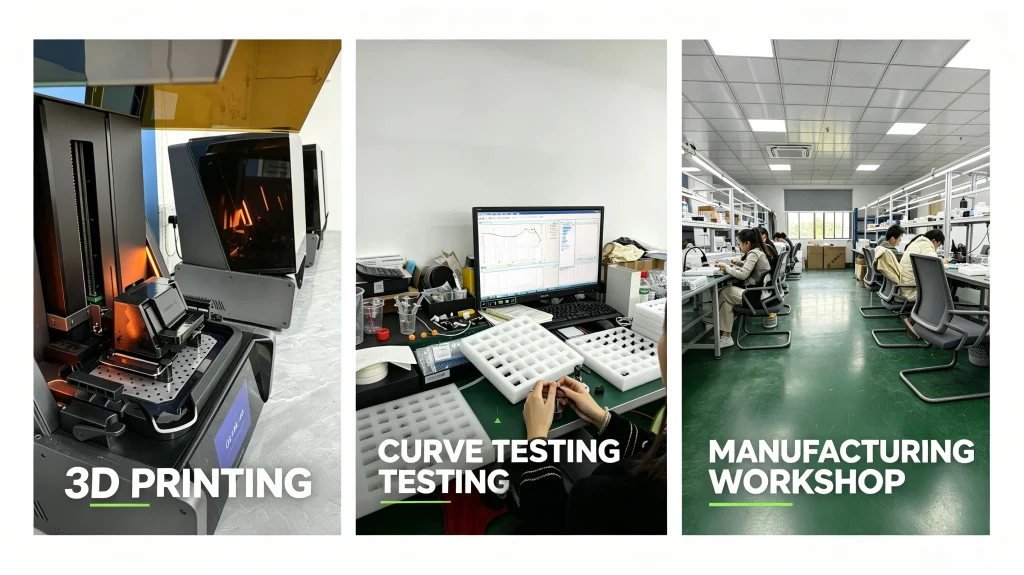
A single bad batch can undo years of brand-building. A shipment held at customs because of missing compliance documentation, a run of earphones with inconsistent left-right balance, or a spike in warranty returns after launch — these are the scenarios that keep procurement managers and audio brand owners awake at night. When your name is on the box, someone else’s manufacturing shortcuts become your reputational risk.
This is why IEM quality control cannot be treated as a paperwork exercise or an afterthought bolted onto the end of production. At BLSeeker, IEM manufacturing compliance and quality assurance are built into every stage of the process, from the moment raw components arrive at our facility to the moment a finished unit is packed for export. This article walks through exactly how that process works — not in marketing language, but in the practical, verifiable steps we take to protect your brand.
The BLSeeker QC Process
Certificates and compliance statements matter, but they only tell part of the story. What actually determines whether your custom IEMs perform consistently, batch after batch, is the discipline of the custom IEM QC process on the factory floor. Our approach is structured around four checkpoints, each designed to catch problems before they reach your customers.
1. Incoming Material Inspection
Every component batch is inspected before it enters production, including:
- Balanced armature and dynamic drivers, checked against agreed sensitivity and impedance specifications.
- Cables, connectors, and solder joints, tested for continuity and mechanical strength.
- Shell materials and faceplates, checked for colour consistency, surface defects, and dimensional accuracy.
Components that fail incoming inspection are rejected and returned to the supplier before they ever reach the assembly line.
2. In-Line Production Checks
Rather than relying solely on end-of-line inspection, we check quality at each assembly stage — driver installation, wiring, shell sealing, and faceplate bonding. Defects are identified and corrected while the batch is still in progress, not after hundreds of units have already been assembled incorrectly.
3. Final Acoustic Testing
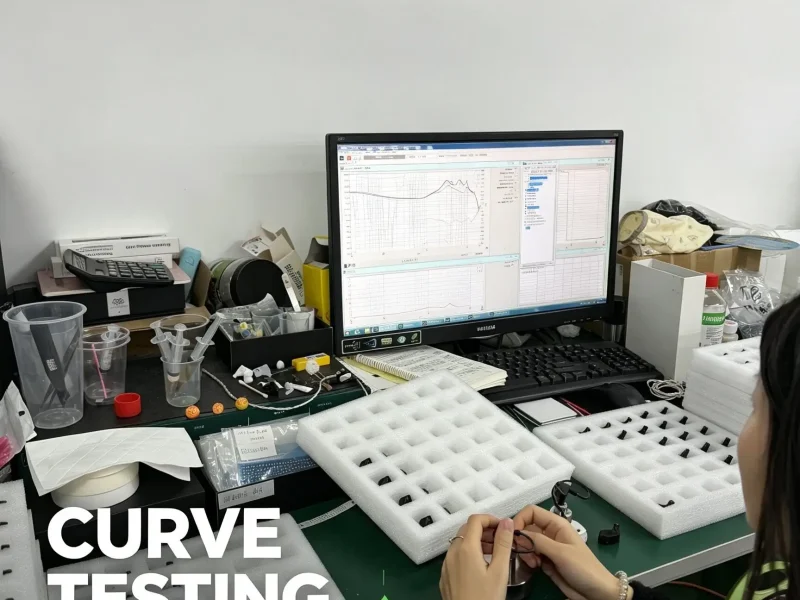
Every finished unit undergoes acoustic testing in our IEM factory using calibrated equipment, including:
- Artificial ear couplers to measure real-world frequency response against the approved tuning target.
- Impedance and sensitivity testers to confirm left-right channel matching and driver performance consistency.
- Listening panel verification for units flagged with any measurable deviation.
4. Aging Test & Drop Test
Before a batch is approved for shipment, sample units are subjected to burn-in aging tests to confirm driver stability over extended use, along with drop tests to verify shell and connector durability under normal handling conditions. This step is designed to catch long-term reliability issues that a simple visual inspection would miss.
Navigating Market Compliance (We’ve Got Your Back)
Manufacturing excellence and regulatory compliance are two different disciplines, and we take responsibility for both. While our engineering team focuses on acoustic and mechanical quality, we also actively support clients through the compliance requirements of their target markets.
All BLSeeker custom IEM production uses RoHS compliant materials as a standard baseline. Furthermore, we provide comprehensive documentation and sample preparation support to assist your brand in smoothly securing CE certification for the European market and FCC compliance for the US market, ensuring your regulatory timeline is never delayed by manufacturing-side gaps.
Defect Rate Control & Transparency
We believe in being direct about quality expectations rather than making vague promises. Our IEM defect rate control process is governed by a standard AQL (Acceptable Quality Limit) sampling methodology, applied at final inspection before shipment. This means every batch is sampled according to internationally recognised statistical sampling levels, rather than a single unit being checked and the rest assumed compliant.
If a batch does not meet the agreed AQL threshold:
- Rework — Units with correctable defects (cosmetic issues, minor assembly faults) are reworked and re-inspected before release.
- Replacement — Units that fail acoustic or functional testing are replaced from verified stock rather than shipped with a known fault.
- Root Cause Analysis — Our QC team investigates the source of the failure, whether it originates from a component supplier or a production step, and implements a corrective action to prevent recurrence in future batches.
Clients receive a QC report summarising sample size, defects found, and corrective actions taken — full transparency, not a pass/fail stamp with no supporting detail.
Standard Workshop vs. Professional IEM OEM Factory
| Factor | Standard Workshop | Professional IEM OEM Factory (BLSeeker) |
|---|---|---|
| Testing Equipment | Basic listening checks, minimal instrumentation | Artificial ear couplers, impedance/sensitivity testers |
| Acoustic Consistency | Unit-to-unit variation common | Verified frequency matching across every batch |
| Incoming Material Checks | Rarely inspected before assembly | Full inspection of drivers, cables, shells |
| Aging & Durability Testing | Not typically performed | Burn-in aging test and drop test on samples |
| Compliance Support | Limited or none | RoHS baseline, CE/FCC documentation assistance |
| Defect Handling | Informal, inconsistent | AQL sampling, rework/replacement, root cause analysis |
| Reporting | Minimal or no documentation | Detailed QC report per batch |
Explore Our Premium Audio Solutions
To achieve the acoustic consistency and manufacturing precision outlined in our QC process, we offer a comprehensive range of customizable audio products tailored to your brand’s exact specifications.
[Custom IEM OEM Manufacturing Services]
[Professional Balanced Armature Drivers & Components]
FAQ
Can you help my brand get CE or FCC certified?
Yes. We provide comprehensive documentation and test samples to assist your brand in smoothly securing CE certification for the EU and FCC compliance for the US, ensuring no manufacturing-side delays.
What acoustic tests do you perform before shipping?
Every batch undergoes frequency response testing against artificial ears, impedance and sensitivity checks for channel matching, and sample-based aging and drop testing to confirm long-term reliability.
What happens if a batch doesn’t meet your quality standard?
Depending on the defect type, the batch is either reworked, replaced from verified stock, or investigated through root cause analysis to prevent the issue from recurring in future production runs. You receive a full QC report either way.
See Our Process for Yourself
Quality claims are easy to make. We would rather show you. Request our Factory QC Video Tour to see the incoming inspection, acoustic testing, and final QC stages in action, or start a live chat with our team to discuss the specific compliance requirements for your target market.
Custom IEM Private Label vs Ready-made?
Low MOQ Custom IEM OEM Worth It?