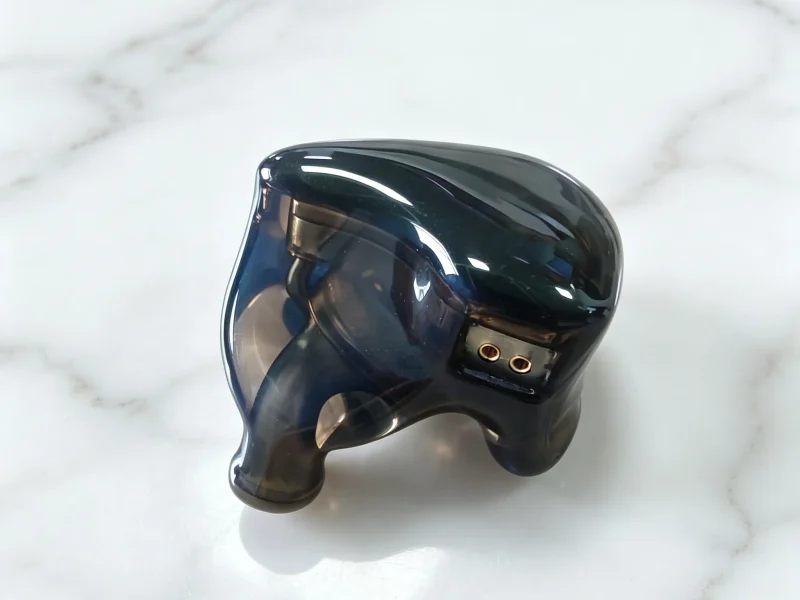
A monitor failure mid-set isn’t a minor inconvenience. It’s a drummer who loses the click track and drags tempo for the rest of the song. It’s a vocalist who can’t hear their own pitch and drifts flat by the second verse. Long-term, it’s cumulative hearing damage from months of compensating with stage volume that’s louder than it should be. Generic earphones fail on tour for predictable, physical reasons — and those reasons are what Custom Stage Monitor IEMs are built to eliminate.
Pain Point 1: Isolation
Passive noise isolation isn’t a comfort feature on stage. It’s what determines whether a performer can hear their monitor mix accurately without cranking output to dangerous levels to compete with stage wash, crowd noise, and backline volume.
A properly fitted custom shell, molded from an individual ear impression, routinely achieves 26dB or more of passive noise reduction. That number matters because it’s the difference between running a monitor mix at a safe listening level and running it loud enough to damage hearing over a touring cycle.
Generic silicone tips can’t match this. They rely on a handful of standardized sizes trying to seal a wide range of ear canal shapes, and an imperfect seal doesn’t just leak sound — it leaks low-frequency response along with it. Performers often compensate by turning up the volume. This directly increases hearing damage risks, defeating the purpose of isolation.
Our [Touring Series Custom IEMs] feature multi-way acoustic dampers. We tune these specifically to the shell’s geometry. This ensures consistent frequency response as soon as you achieve a proper seal.. The isolation figure only means something if the tuning behind it is dialed in — a loose seal with a good driver still sounds worse than a tight seal with mediocre tuning.
Pain Point 2: Durability
Isolation solves the hearing and mix-accuracy problem. Durability solves the other one: keeping the unit functional through months of load-in, load-out, sweat exposure, and repeated cable handling.
Shell material matters here. Acrylic and medical-grade resin shells hold dimensional stability under repeated temperature and humidity swings — a tour bus in July and an air-conditioned venue in the same day put real stress on shell materials that aren’t engineered for it. A shell that warps even slightly compromises the custom seal the isolation depends on.
Cable connectors are the more common failure point in practice. A 0.78mm 2-pin connector, properly specified and reinforced at the housing, holds up to repeated insertion cycles and lateral pulling far better than a fixed cable or a loosely toleranced MMCX substitute. Connector failure is the single most frequent repair request from touring clients, and it’s almost always traceable to an under-specified connector housing rather than the cable itself.
For high-intensity touring schedules, we recommend our [Professional Stage Monitor Solution], built with reinforced connector housings and moisture-resistant internal coating on the driver assembly. It’s specified for the failure modes that actually show up on the road, not for a spec sheet.
Q&A
What’s the typical production lead time for a bulk touring IEM order?
Standard lead time runs 3–5 weeks from confirmed ear impressions and approved tuning specification to finished production, depending on order volume and shell complexity.
What’s the MOQ for a custom stage monitor order?
MOQ varies by driver configuration, but most touring orders start at a scale that supports a full band or crew — smaller pilot orders can be arranged for brands validating a new product line before committing to volume.
Do you offer sample units before a full order?
Yes. We recommend a sample round to confirm fit, isolation, and tuning against your specification before moving to production, particularly for first-time clients or new driver configurations.
Next Read
If your monitoring needs extend beyond live performance into mixing or mastering work, our article on Studio Monitor IEMs covers flat frequency response and target curve tuning — a different technical priority than touring durability, but relevant if your engineers split time between stage and studio work.
Related Articles:The Pro-Sumer Sweet Spot: Positioning True Wireless Custom IEMs
Why Pro Musicians Still Prefer Wired: The Latency & Soundstage Reality